



There is a moment in online shopping that most e-commerce websites are not very good at handling. The customer has found what they were looking for. Maybe they searched for running shoes, a laptop, a sofa, or a jacket. They used the filters, looked through the results, opened a few product pages, and narrowed the list down.
Now they have three or four options that all seem reasonable.
And they are still not sure what to buy.
At this point, another filter doesn’t really help. Neither does another page of product specifications. They are not looking for more products. They are trying to work out which of the products in front of them makes the most sense.
That is the part of shopping that e-commerce has largely left to the customer.
Online shopping has spent twenty years getting better at narrowing a catalog. Search is faster, filters are deeper, product pages carry more detail and reviews are everywhere. A shopper can get from ten thousand products to a handful in minutes.
But narrowing a catalog and making a decision are different jobs. Once a shopper is down to two or three solid options, another filter has nothing left to filter, and another spec table only adds more to compare. The shopper knows their own situation. What they can’t easily do is translate it into the right product. A desk’s “height range,” a mattress’s “firmness rating” and a lens’s “focal length” are all numbers the shopper has to interpret on their own.
More choices can make the decision worse
It’s tempting to assume that showing more relevant products always helps. The research says otherwise.
A field experiment on an Alibaba retail platform sent follow-up recommendation messages to 1.6 million consumers, each message showing between one and four products.
Showing two products led to more purchases than showing one. Showing three or four led to fewer purchases than showing two.
The researchers found that as much as 64% of that drop came from shoppers not even starting to look at the recommendations.
So a long list of “recommended for you” items can be a burden. Even a short list doesn’t say why one item beats the others, and that “why” is what the shopper is actually missing.
What a useful recommendation sounds like
Take two products, one with better materials and one with stronger reviews. A comparison table lays out every difference. It can’t tell the shopper which differences matter to them.
Here is what Tom would want to hear:
Tom: I’ve narrowed it to two standing desks. Which one should I get?
Crossword: You mentioned you’re 6'3" and short on space. The Ridge raises to 51 inches, so you’ll stand comfortably. The Loft stops at 46 and would leave you hunched. If you were under 5'10", the Loft would do the job and save you the money.
Tom didn’t need a ranking. He needed the trade-off explained in terms of his own situation. Preferences also shift during that process. A shopper who opens with “cheapest” and later says durability matters more doesn’t want the first statement forgotten. A good assistant keeps both in mind, and the shopper can change course without starting over.
Help with the decision, but leave the decision to the shopper
None of this means handing the purchase to a machine, and shoppers are clear about that. A Gartner survey of 322 US consumers in January 2026 found that only 11% would let AI make a purchase decision, even in low-stakes categories like personal care and household supplies. Far more were open to AI narrowing their options: 31% for household supplies and 28% for electronics.
A second Gartner survey of 846 consumers explains some of the caution. Among shoppers who used generative AI in a recent purchase, 54% had to double-check everything it told them, and 62% said the information wasted their time. If an assistant is going to explain trade-offs, its answers must come from the brand’s own product information, not from guesses.
The conversation may not start on your site
Tom could have narrowed his shortlist inside ChatGPT or with a personal AI agent before ever visiting a store. That’s where shoppers are heading. Adobe found that AI-referred traffic to US retail sites grew 393% year over year in Q1 2026, and those visitors converted 42% better in March.
That raises a new question for brands. If the shortlist is built somewhere else, does the assistant building it understand your products correctly? Adobe scored the average retail product page at only 66% machine-readable, which means the assistant may be working from incomplete information. And when the shopper does arrive, will your site pick up where that conversation left off, or ask them to begin again at a search bar?
Where Crossword fits
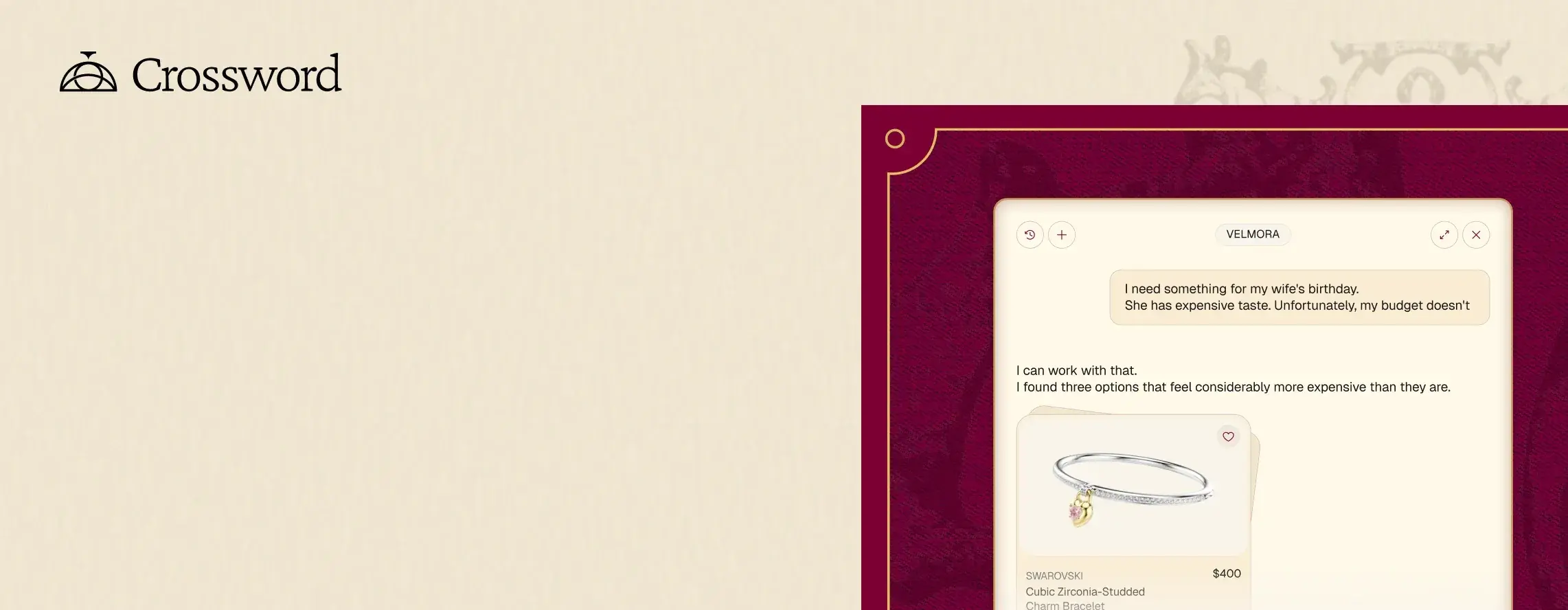
Crossword is built for this stage of shopping, when the shopper has a list and needs help choosing.
It starts with the shopper’s own words. Say Tom asks for a desk that works for someone tall in a small apartment. Crossword turns that into the attributes that matter, like height range and footprint, using the brand’s own catalog. If something important is missing, it asks one focused follow-up question instead of presenting a wall of filters.
Then it helps with the choice. It compares two products, says whether the pricier one is worth it for this shopper, and explains why in plain language.
Crossword keeps track of what the shopper has said, both within a conversation and across visits. When Tom comes back for a monitor arm, it already knows he’s tall and short on space. Shoppers stay in control, because their preferences come only from what they chose to share, and they can change them just by saying so.
Crossword doesn’t stop at the brand’s website. It acts as the AI agent for your brand, connecting ChatGPT, Gemini, Claude and shoppers’ personal agents directly to your store, with your catalog enriched so they get your product information accurately and completely. The shopper gets the same knowledgeable help wherever they happen to be asking.
For the brand, every conversation shows what shoppers are trying to do, which trade-offs make them hesitate, and which questions the product pages never answered. It’s feedback that click data alone can’t give you.
The goal isn’t to replace browsing or to turn every visit into a chat. It’s to help cover the step that online stores have long left to the shopper: choosing easily.
What brands can do now
Start with three questions:
1. Where do shoppers stall? Look at product pages with high views and low add-to-cart. Those are the places where shoppers are stuck choosing.
2. Is your brand readable to the AI assistants shoppers already use? Complete attributes, live pricing and inventory, and content that answers real questions are what let an assistant represent you correctly.
Frequently asked questions
What is the “help me choose” problem in e-commerce? It’s the gap between finding products and deciding on one. Shoppers can narrow a catalog with search and filters, but most stores offer little help once the shortlist is down to a few similar options.
Why can showing more recommendations hurt sales? In a field experiment with 1.6 million consumers, purchase likelihood first rose and then fell as more recommended products were shown. Much of the drop came from shoppers not engaging with the list at all.
How is an AI shopping assistant different from a recommendation engine? A recommendation engine ranks products. An AI shopping assistant talks with the shopper, asks about their needs, compares options and explains why one fits them better.
What is an AI agent for brands? Crossword represents a brand wherever shoppers ask questions: on its own site, in ChatGPT or through a shopper’s personal agent. It uses the brand’s own product data so the answers are accurate. Talk to the team today.
The question to ask
Shoppers can already find your products. The question for any brand now is who helps them choose, and whether that help is based on what you actually sell.